







Cyber Defense Masterclass
Offensive Pentesting (Red Team)
Defensive SOC & Blue Team
CEH v13 & OSCP Readiness
The digital landscape has transformed into an active theater of continuous cyber warfare. High-profile ransomware syndicates, nation-state Advanced Persistent Threats (APTs), zero-day weaponization, and software supply-chain compromises have elevated information security from an isolated IT support task to an existential corporate mandate. Across Pakistan, the Middle East, North America, and European enterprise corridors, financial institutions, telecom carriers, health networks, and cloud service providers face a staggering shortage of qualified security practitioners.
Transitioning into high-paying infosec roles requires far more than theoretical memorization. Employers actively hunt for hands-on talent capable of conducting ruthless Vulnerability Assessment and Penetration Testing (VAPT) on one front, while architecting 24/7 detection engineering across Security Operations Centers (SOC) on the other. Whether you are aiming to enroll in a premier Cyber Security Course in Lahore, earn global credentials such as CompTIA Security+, CEH (Certified Ethical Hacker), and OSCP, or establish yourself as a regional digital defense authority, this blueprint details the end-to-end technical syllabus demanded by the modern cybersecurity market.
Unified Security Syllabus Blueprint
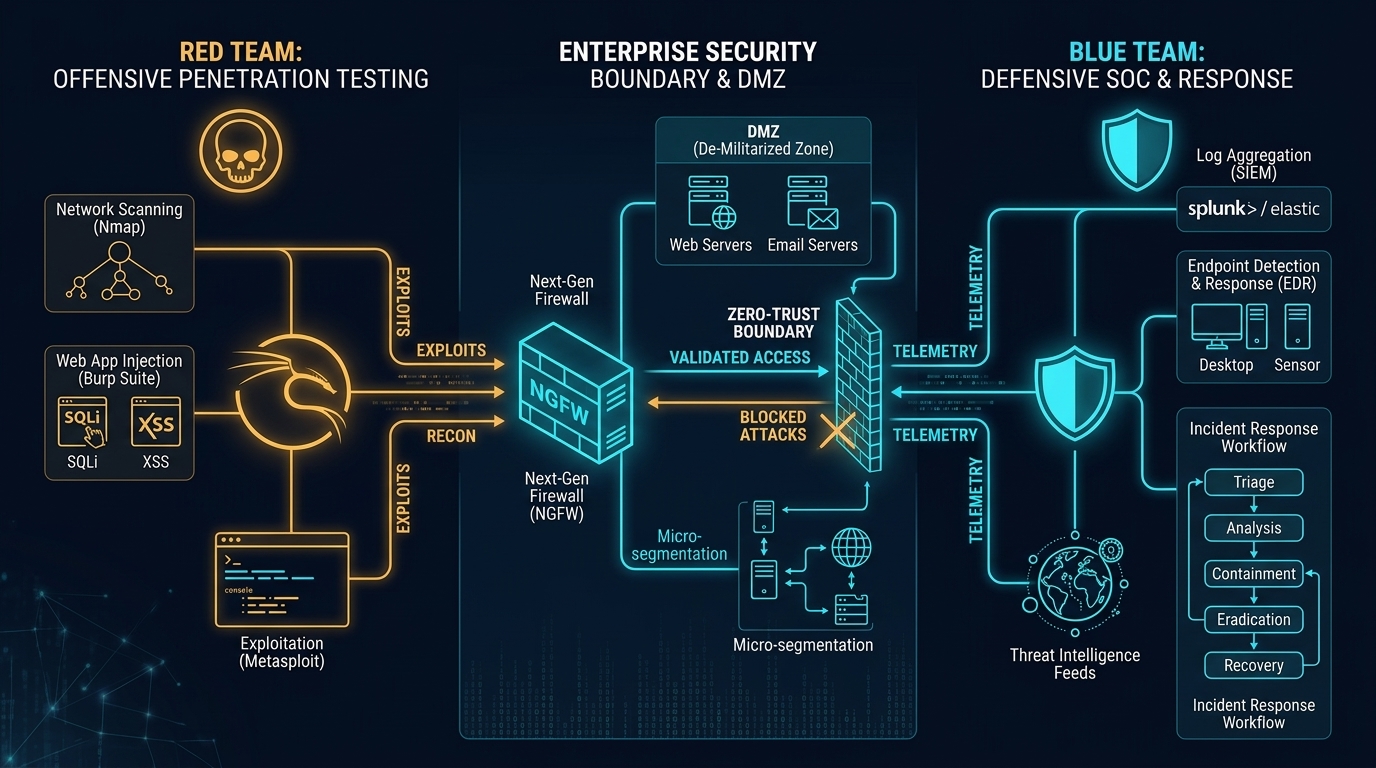
Offensive + Defensive ConvergenceThe Dual-Engine Infosec Architecture: Red Team & Blue Team Synergy
Elite security practitioners understand both sides of the coin. An offensive penetration tester cannot bypass modern endpoint defenses without understanding SIEM telemetry, and a defensive SOC analyst cannot triage malicious payloads without understanding attack toolkits:
TCP/IP attack surfaces, packet crafting, port hardening, symmetric/asymmetric encryption, PKI architectures, and Zero-Trust network perimeters.
5-phase penetration testing, Kali Linux weaponization, Metasploit exploitation, OWASP Top 10 web injection (SQLi, XSS), and Active Directory privilege escalation.
Splunk & Elastic SIEM log correlation, NIST incident response lifecycle, EDR telemetry analysis, malware sandbox triage, and threat hunting.
Module 1: Foundational InfoSec, Boundary Defense & Cryptographic Architecture
Every sophisticated exploit takes advantage of structural flaws in network protocols or misconfigured operating system boundaries. Before executing exploitation scripts, engineers must understand the underlying protocols they manipulate:
TCP/IP Attack Surfaces & Port Hardening
Auditing and mitigating protocol-level exposures across the Open Systems Interconnection (OSI) hierarchy:
- Layer 2 Vulnerabilities: Address Resolution Protocol (ARP) poisoning, CAM table exhaustion, and DHCP starvation attacks. Remediation via Dynamic ARP Inspection (DAI) and DHCP Snooping.
- Layer 3 & 4 Exploits: TCP SYN flood DoS, IP spoofing, ICMP redirect hijacking, and fragmentation attacks. Mitigated through TCP SYN cookies and rate limiting.
- Port & Service Hardening: Eliminating unencrypted cleartext protocols (Telnet Port 23, FTP Port 21, HTTP Port 80) and securing high-risk administrative entrypoints (SSH Port 22 key-only authentication, disabling SMBv1 Port 445, disabling RDP Port 3389 without Network Level Authentication).
Modern Cryptography & Public Key Infrastructure (PKI)
Securing corporate data-in-transit and data-at-rest using resilient mathematical algorithms:
- Symmetric vs. Asymmetric Encryption: Leveraging Advanced Encryption Standard (AES-256-GCM) for high-speed bulk data ciphering, paired with Rivest-Shamir-Adleman (RSA-4096) or Elliptic Curve Cryptography (ECC Curve25519) for secure key exchanges.
- SSL/TLS 1.3 Handshake Architecture: Ensuring Perfect Forward Secrecy (PFS) via Ephemeral Diffie-Hellman (ECDHE), preventing retroactive decryption even if long-term server private keys are compromised.
- Cryptographic Hashing & Salting: Differentiating collision-vulnerable legacy algorithms (MD5, SHA-1) from cryptographically secure hash functions (SHA-256, SHA-3, Argon2id, bcrypt for credential stores).
Enterprise Boundary Defense: NGFWs, DMZ & Zero-Trust
Modern perimeter defense has evolved beyond simple stateless packet filtering into deep, identity-aware inspection:
Integrating Deep Packet Inspection (DPI), Application Identification (App-ID), SSL/TLS decryption inspection, and real-time threat prevention signatures on Palo Alto, Fortinet, and pfSense.
Structuring dual-homed Demilitarized Zones (DMZ) to cleanly quarantine public-facing web/mail servers from high-value internal corporate Active Directory databases.
Deploying Snort and Suricata signature engines in inline IPS mode to detect port sweeps, exploit payloads, and C2 beacons before packets enter the local LAN.
Module 2: Advanced Ethical Hacking & Offensive Penetration Testing
True ethical hacking is an analytical, methodical engineering discipline. Adhering to the 5 industry-standard phases of penetration testing ensures comprehensive vulnerability discovery while preventing unintended system disruption:
The 5 Phases of Ethical Hacking & VAPT
nmap -sS -sV -sC -T4 -p-) to uncover open ports, software daemon versions, and operating system fingerprints. Directory fuzzing using Gobuster and Dirsearch to discover hidden administrative portals.msfconsole), compiling public CVE proofs-of-concept (PoC), crafting custom reverse shells using msfvenom, and executing client-side social engineering payloads in controlled test environments.OWASP Top 10 Web Application Vulnerabilities
Web applications are the primary target vector for modern corporate intrusions:
- SQL Injection (SQLi): In-band, boolean-blind, and time-based SQL injection via Burp Suite and SQLmap. Remediated by replacing dynamic string concatenations with parameterized Prepared Statements.
- Cross-Site Scripting (XSS): Stored, Reflected, and DOM-based script injection enabling session hijacking. Remediated via strict context-aware output encoding and Content Security Policy (CSP) headers.
- Broken Object Level Authorization (BOLA / IDOR): Manipulating identifier parameters to view unauthorized user data. Remediated by enforcing server-side session-based object ownership validation.
- Server-Side Request Forgery (SSRF): Coercing vulnerable backends into querying internal cloud metadata endpoints (e.g. AWS
169.254.169.254).
Privilege Escalation: Linux & Active Directory
Elevating initial unprivileged shell access to full root or Domain Administrator:
- Linux Privilege Escalation: Automated enumeration via LinPEAS, inspecting misconfigured SUID binaries (GTFOBins), exploiting vulnerable sudoers entries (
sudo -l), and abusing writable cron scripts. - Windows AD Kerberos Attacks: Executing Kerberoasting to extract service account ticket hashes and cracking them offline with Hashcat. Conducting AS-REP Roasting against accounts without pre-authentication required.
- Active Directory Domain Compromise: Visualizing complex trust paths using BloodHound, executing Pass-the-Hash (PtH) with Mimikatz, and abusing unquoted service paths.
Module 3: Modern SOC Operations, SIEM Engineering & Incident Response
Breaches are inevitable; persistence is unacceptable. A modern Security Operations Center (SOC) operates as the enterprise central nervous system, continuously analyzing billions of events to detect, contain, and eradicate cyber adversaries.
SIEM Engineering & Detection Logic (Splunk & ELK)
Aggregating cross-platform telemetry into centralized data analytics lakes:
- Log Ingestion Pipelines: Harvesting Linux syslog (auth.log), Apache/Nginx web access logs, firewall connection state tables, and Microsoft Sysmon telemetry.
- Critical Windows Security Event IDs: Auditing Event 4624 (Successful Logon), Event 4625 (Failed Logon / Brute Force indicator), Event 4688 (New Process Created), and Event 7045 (New Service Installed / Persistence).
- Correlation & Alert Engineering: Writing Search Processing Language (SPL) queries in Splunk and KQL rules in Elastic Security to trigger automated high-severity tickets when abnormal logon patterns or outbound beaconing thresholds are breached.
Incident Response Lifecycle (NIST SP 800-61)
Structured containment methodology during active cyber security breaches:
- 1. Triage & Scoping: Validating alert veracity, distinguishing genuine intrusions from false positives, and identifying compromised endpoint subnets.
- 2. Isolation & Containment: Dynamically isolating infected hosts via Endpoint Detection & Response (EDR) agent policies and terminating malicious network connections at the firewall perimeter.
- 3. Eradication & Root Cause Analysis: Removing malware binaries, terminating unauthorized persistence tasks, revoking compromised Kerberos tickets, and resetting administrative credentials.
- 4. Post-Incident Review: Documenting lessons learned, updating defense signatures, and remediating the root exploit vector to prevent recurring breaches.
Malware Analysis & Endpoint Detection (EDR / XDR)
Dissecting adversarial code in isolated air-gapped forensic environments:
Generating cryptographic hashes (MD5, SHA-256) to query VirusTotal and threat intelligence repositories. Extracting ASCII/Unicode strings, parsing Portable Executable (PE) headers with PE-bear, and analyzing import address tables (IAT) for suspicious DLL invocations.
Detonating malware inside isolated virtual machines (FLARE VM, Cuckoo Sandbox, Any.Run). Monitoring real-time registry modifications (Regshot), process tree injections (Procmon), and outbound Command & Control (C2) callback beacons using Wireshark.
Enterprise Cybersecurity Skills, Tooling & Career Matrix
This multi-tier skills matrix maps core technical modules directly to industry-standard tools, certification pathways, and high-growth operational career roles:
| Security Domain | Hands-On Platforms & Toolkits | Industry Certifications | Target Enterprise Job Roles |
|---|---|---|---|
| Offensive Security Penetration Testing & VAPT | Kali Linux, Metasploit, Nmap, Burp Suite Pro, Hydra, Hashcat, BloodHound, Mimikatz | CEH v13, OSCP (Offensive Security Certified Professional), CompTIA PenTest+ | Penetration Tester, Red Team Specialist, Ethical Hacker, VAPT Consultant |
| Defensive Security SOC Operations & SIEM | Splunk Enterprise, Elastic SIEM (ELK), Wazuh, Wireshark, Snort, Suricata, Sysmon | CompTIA CySA+, CompTIA Security+, Microsoft Certified: SC-200, Cisco CBROPS | SOC Analyst (Tier 1 & Tier 2), Threat Hunter, Incident Response Engineer |
| AppSec & Web Security Application Defense & Cloud | OWASP ZAP, Postman, SQLmap, ModSecurity WAF, Cloudflare Zero Trust, Docker Bench | Certified Web Application Defender (EC-Council), AWS Certified Security Specialty | Application Security Engineer, Cloud Security Specialist, DevSecOps Engineer |
| Governance & GRC Auditing & Frameworks | NIST CSF, ISO 27001 ISMS, MITRE ATT&CK Matrix, CIS Controls, OpenVAS | CISSP (Certified Information Systems Security Professional), CISM, CRISC | Information Security Officer (CISO track), IT Compliance Auditor, Risk Analyst |
Frequently Asked Questions: Cybersecurity & Ethical Hacking
- What are the essential technical prerequisites to learn Ethical Hacking and Cyber Security?
Aspiring cybersecurity engineers must possess a solid foundation in computer networking (understanding TCP/IP protocols, subnetting, DNS, and OSI layers — equivalent to CCNA concepts) and core operating system fundamentals (Linux command-line navigation and Windows administration). Familiarity with basic scripting (Python or Bash) is highly beneficial for automation, but prior professional software development experience is not required to enter Tier 1 SOC analysis or junior penetration testing.
- What is the difference between CEH (Certified Ethical Hacker) and OSCP (Offensive Security Certified Professional)?
CEH (Certified Ethical Hacker) is an industry-recognized, knowledge-based certification featuring multiple-choice questions covering ethical hacking methodologies, regulatory frameworks, tools, and defensive countermeasures. It is widely demanded by corporate HR departments, government entities, and IT compliance audits. In contrast, OSCP is a rigorous, 24-hour hands-on practical exam where candidates must compromise live target machines in a private lab network and submit an executive penetration testing report. CEH provides the foundational breadth, while OSCP proves deep tactical exploitation mastery.
- What is the career scope and employment demand for SOC Analysts and Penetration Testers in Pakistan and the Middle East?
With mandatory State Bank of Pakistan (SBP) cybersecurity directives and international ISO 27001 compliance standards, commercial banks, fintech startups, software houses, and telecom operators in Lahore, Karachi, and Islamabad are heavily expanding internal 24/7 SOC teams. Furthermore, regional demand across the UAE, Saudi Arabia (KSA), and Qatar offers lucrative international remote and on-site contracts for certified professionals holding credentials like CompTIA Security+, CEH, and CySA+.
- Which operating system is superior for beginners: Kali Linux or Parrot Security OS?
Both distributions are Debian-based and feature extensive pre-installed security toolkits. Kali Linux (maintained by Offensive Security) is the global standard with the largest community support, documentation, and tool repository compatibility. Parrot Security OS is slightly lighter on system resources and offers a polished desktop interface with integrated privacy/anonymity features (AnonSurf). For certification preparation (such as CEH and OSCP), Kali Linux is recommended due to standard exam lab alignment.
- How can I safely configure an isolated home lab for ethical hacking and penetration testing practice?
Never test offensive security tools on public networks or production machines. Build an isolated virtualized lab using hypervisors like VMware Workstation or VirtualBox. Configure an internal “Host-Only” or private virtual switch (NAT network) isolated from your home router. Deploy an attacking VM (Kali Linux) alongside dedicated practice target VMs such as Metasploitable 2/3, OWASP Juice Shop, Damn Vulnerable Web App (DVWA), and VulnHub machines. Complement this with legal, cloud-hosted platforms like Hack The Box (HTB) and TryHackMe.